Tour and Travel

Nature

Innovation

Family Health

Find out the most enjoyable moments with precious Life care and Health

Celebrity Gossip

Showing posts with label Angela Merkel. Show all posts

Monday, 4 June 2012

0 Germany sells Israel Nuclear-equipped submarines

Der Spiegel has just published an important article about the Dolphin submarines Germany has been selling to Israel over the past fifteen years.  Israel now has three, with a fouth and fifth on the way and sixth in the pipeline by 2017.  Sale of up to nine submarines is contemplated by both sides.  The ostensibly big news in this story is that both the Israelis and Germans knew the subs were nuclear weapons-capable, but the Germans had denied it.  In fact, they contain a special secret hydraulic launching system designed for nuclear cruise missiles.

Germany sells Israel Nuclear-equipped submarines

But this isn’t the real news since any reasonably intelligent person would know that any submarine Israel would buy would carry nuclear weapons.  There are two truly newsworthy aspects of this story: one reported and the other not.  The reported one is that German chancellor Angela Merkel officially denied the subs would carry nukes all the while knowing they would.  That is a big story, no doubt, in Germany.  In Israel it’s pretty much a yawn, given that Israelis are used to their leaders lying through their teeth on national security and military matters.

But what has not been reported and is probably the most important aspect of this story is the major upheaval it will introduce in the Middle East balance of power.  Der Spiegel notes that the nukes on board the Dolphins will offer Israel a “second strike” capacity against any enemy who thinks to level a crippling pre-emptive blow against it.  Ostensibly, this will make a power like Iran, after it would get nuclear weapons (if it would), think twice about using the nukes since Israel’s cruise missiles will level entire Iranian cities.

But the question must be asked: who in the Middle East has the power to mount such an attack against Israel?  No one.  Iran doesn’t even have nukes and certainly can’t attack Israel without them.  There simply is no other country that could do so.  Perhaps in one’s wildest dreams one could imagine Israel and Turkey tussling with the Turks thinking of striking a crippling blow against Israel.  But essentially, no one in the Middle East could mount a first strike.  So in effect Israel is getting a weapon for a purpose that doesn’t exist.  Why should it need second strike capacity when there is no first strike possible?  It’s a little like running for president even before you’ve been elected to the school board.

From this flows an even more important development.  I recently posted about a conversation I had with noted Israeli nuclear weapons analyst Avner Cohen about the hidden impact of Israel’s nuclear arsenal on strategic military and policy matters that one would never think could be influenced by nuclear weapons.  Namely, that a nuclear-weapons-enabled Israel has no reason to compromise either with its neighbors or with its allies on any major issues like ending Occupation, returning to 1967 borders, etc.  Just as North Korea’s nukes have enabled it to maintain a surprisingly belligerent posture towards its enemies and even its Chinese friends, Israel too can thumb its nose at anyone asking it to make concessions it isn’t prepared to make.

An Israel with nukes can even tell a U.S. president that he can take his settlement freeze and shove it.  That’s precisely what Bibi Netanyahu did and Pres. Obama didn’t have the guts to pursue the matter.  After all, what leverage did Obama have unless he was willing to go to the mat and invest everything in winning?

There is another macabre irony in Germany’s sale of these weapons to Israel.  The state which inflicted the Holocaust on the Jewish people and incinerated 6 million of them in the ovens of Poland, has now dealt Israel the ability to incinerate any Arab country so bold as to stand in the way of Israeli hegemony over its little slice of the Middle East.  If an Israeli missile is ever fired at an Arab state and inflicts major damage upon it, this will be one of the first things the media will mention.  And Germany will then, too late, have some soul-searching to do about giving Israel the power to inflict its own Holocaust on the Mideast.

Ah yes, the right-wing naysayers will protest at references to an Israeli-inflicted Holocaust because it can’t and won’t happen here (or I should say, there).  Israel would never deliberately kill more than say the ten or fifteen thousand Arabs its killed since 1948.  It would never kill, say a hundred thousand or a million.  Unfortunately, history has offered up the American example of two atom bombs used against Japan within a week.  Though no one has used a nuclear weapon since, we let the bomb out of Pandora’s Box and Israel would clearly be willing to use it if it had to.  Can anyone say that they’d trust Israel’s judgment in using such a weapon as an absolute last resort to stave off national catastrophe?

Germany has offered the subs to Israel on terms that what can only be called a sweetheart deal: the seller finances one-third of the purchase price ($168-million), but Israel doesn’t make its first payment till 2015.  Is Germany that desperate for customers that it had to practically pay the Israelis to buy weapons that can incinerate half the Middle East?

It seems to me that right about this time some German moral thinkers (aside from Gunter Grass, whose criticism of the sub deal was right on the mark) and peace activists should be doing some very deep soul-searching about why their country has offered a weapon of such enormous power to a country which has done nothing but resist making peace in the region over the past 45 years or more.

It’s worthwhile noting Ehud Barak’s hearty congratulations offered to the German people:

Israeli Defence Minister Ehud Barak told SPIEGEL that Germans should be “proud” that they have secured the existence of the state of Israel “for many years.”

These weapons have done much more than secure Israel’s existence.  They’ve secured Israel’s ongoing intransigence in any matters pertaining to peace negotiations.  This in turn makes the Middle East a much more unstable place, which doesn’t render Israel more secure, but rather less.

Thanks:muslimvillage.com/2012/06/05/23902

Sunday, 20 May 2012

0 NATO shifts to help an elusive Afghanistan peace

President Barack Obama and NATO allies declared Sunday that the end of the long and unpopular Afghanistan war is in sight even as they struggled to hold their fighting force together in the face of dwindling patience and shaky unity.

From his hometown and the city where his re-election operation hums, Obama spoke of a post-2014 world when "the Afghan war as we understand it is over." Until then, though, remaining U.S. and allied troops face the continued likelihood of fierce combat.

G8 Summit Chicago 2012

Gen. John Allen, the top commander of U.S. and NATO forces in Afghanistan, offered a stern warning Sunday that the plan to give Afghan forces the lead in fighting next summer won't take coalition troops out of harm's way. "It doesn't mean that we won't be fighting," Allen said. "It doesn't mean that there won't be combat."

The fate of the war is both the center of this summit and a topic no one is celebrating as a mission accomplished. The alliance already has one foot out the Afghanistan door, Obama has his ear attuned to the politics of an economy-driven presidential election year and other allies are pinching pennies in a European debt crisis.

As NATO powers and other nations contributing to the war effort gathered, the alliance's top officer, Anders Fogh Rasmussen, asserted that "there will be no rush for the exits" in Afghanistan. "Our goal, our strategy, our timetable remain unchanged," he said.

In fact, the strategy has shifted many times over the course of more than 10 years of war, and the goal narrowed to objectives focused on the long-term security of the mostly Western nations fighting there. The timetable has also moved, despite the overall commitment to keep foreign forces in Afghanistan into 2014.

Tension over newly elected French President Francois Hollande's pledge to end his country's combat mission two years early infused the meeting. German Chancellor Angela Merkel pointedly cited the credo of the allies in the Afghanistan war, "in together, out together," and her foreign minister cautioned against a "withdrawal competition" by coalition countries.

Hollande said he was merely being pragmatic in keeping a campaign pledge to pull combat troops this year but this still would "let the alliance continue to work."

While France's new posture obviously rattled the leaders, Allen betrayed no concern about the coalition's common purpose coming unglued. "The mantra of this particular mission has been in together, out together," he told reporters. "And I'm not seeing, frankly, many voices being raised that would oppose that."

Thursday, 17 May 2012

0 Cameron Takes Eurozone Demands To US Summit

David Cameron is set to step up his demands for action to tackle the eurozone crisis as he heads to the United States for a two-summit weekend with world leaders. 

The Prime Minister travels first to a gathering of G8 leaders at the US President's country retreat at Camp David before attending a Nato summit in Chicago.

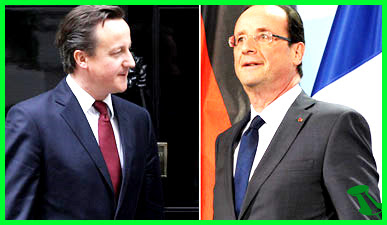
Cameron and Hollande

The G8 talks will be dominated by the eurozone crisis and the threat posed to world economies, initernational currencies and markets by the financial collapse and political vacuum in Greece.

Before leaving Downing Street, Mr Cameron took part in a 45-minute video conference, described by Number 10 as "constructive", with the other European leaders attending the G8.

Taking part were German chancellor Angela Merkel, new French president Francois Hollande, Italian premier Mario Monti and EU Commission chiefs Manuel Barosso and Herman Van Rompuy.

"He discussed with the others their priorities for G8; the Eurozone - including Greece, growth, and the importance of expanding trade relations between the US and the EU," said a Downing Street spokesperson.

"On the eurozone, the Prime Minister emphasised the importance of Greece and the Eurozone taking decisive action to ensure financial stability and prevent contagion."

Mr Cameron was said to have repeated the stark warning he issued in a speech in Manchester earlier yesterday: "That there is a need for monetary action to stimulate growth; for structural reform to increase competitiveness in the EU; that the right governance arrangements had to be in place; and that countries throughout the Eurozone should take the necessary action to tackle unsustainable deficits."

In that speech, the Prime Minister said he would do "whatever it takes to keep Britain safe from the storm", but made clear that the UK would not be immune to the consequences of a euro collapse.(Google)

And he insisted he would not ditch the Coalition Government's deficit-reduction strategy in the face of demands from Labour for a shift in focus from austerity to growth.

Before leaving Camp David for the Nato summit in Chicago, Mr Cameron will hold his first one-to-one meeting with Mr Hollande - whom he snubbed when the Socialist presidential candidate visited London earlier this year - at the British ambassador's residence in Washington.

The Prime Minister will urge the new president to rethink his pledge to pull 3,400 French troops out of Afghanistan two years ahead of Nato's planned timetable of 2014.


Monday, 14 May 2012

0 George Osborne: Angela Merkel damaging UK economic interests

George Osborne accused Angela Merkel of damaging Britain’s economic interests after she speculated that Greece would leave the euro.

Speaking after he arrived in Brussels for meetings with other European finance ministers about the worsening eurozone crisis, Mr Osborne implied that the German chancellor was destabilising the global economy.

George Osborne:Angela Merkel damaging UK

“The eurozone crisis is very serious and it’s having a real impact on economic growth across the European continent, including in Britain, and it’s the uncertainty that’s causing the damage,” said Mr Osborne, the Chancellor.

“Of course countries have got to make difficult decisions about their public finances. We know that in Britain. But it’s the open speculation from some members of the eurozone about the future of some countries in the eurozone which I think is doing real damage across the whole European economy.”

Earlier Mrs Merkel had warned that Greece may be forced to leave the euro if it refused to implement spending cuts agreed with the European Union.

Raising the spectre of a Greek exit, she said “solidarity for the euro” was threatened by the ongoing political crisis in Athens.

Jean-Claude Juncker, the chairman of the eurogroup of finance ministers, usually a staunch supporter of Mrs Merkel’s austerity measures, also criticised her last night, accusing Germany and other hawkish EU countries of using Greece to make “propaganda”. “I don’t envisage, even for a second, Greece leaving. It is nonsense, it is propaganda,” he said.

“I am against this way of dealing with Greece by provoking Greek public opinion. Threatening Greece day after day is not the way of dealing with partners, friends and citizens.”

Stock markets around the world fell sharply with fears mounting that a euro break-up could lead to renewed financial turmoil. The FTSE-100 index of Britain’s major companies fell by two per cent to 5465, with bank shares hit particularly hard. The cost of Spanish government borrowing also hit a record high.

The row leaves Mrs Merkel even more isolated from key eurozone allies as she faces tough negotiations on growth versus austerity with François Hollande, the new Socialist French President, in Berlin today. Mr Hollande will be sworn in and, in an indication of the concern gripping Europe, will almost immediately travel to Berlin to hold talks with Mrs Merkel that will be dominated by Greece’s plight.

Attempts to form a new government in Athens have been thwarted for the past nine days, although the country’s president will meet all major parties this afternoon to discuss forming a “technocratic” administration rather than a coalition.

An outgoing Greek minister warned that the country could descend into “civil war” amid the chaos of a euro exit.

“If Greece cannot meet its obligations and serve its debt the pain will be great,” Michalis Chrysohoidis was quoted as telling a local radio station. “What will prevail are armed gangs with Kalashnikovs and which one has the greatest number of Kalashnikovs will count … we will end up in civil war.”

New elections may be held next month and Greek voters are likely to be warned by European leaders that their country may be ejected from the euro if they do not support parties backing austerity measures.

Today, Mr Osborne may agree to looser banking rules, stipulating how much money banks must keep on their balance sheets, to allow more flexibility in responding to the turmoil.

A report from Fitch, the credit rating agency, said yesterday that the British economy may not re-emerge from recession before 2014 if there is a “shock case” of a disorderly Greek exit from the euro.

Germany and the European Central Bank are thought to have drawn up detailed plans for a Greek exit for the euro. They are designed to stop it provoking panic in other vulnerable countries, particularly Spain and Ireland.

However, this is fraught with difficulties, particularly if Greece refuses to take part in a “negotiated exit”. Mrs Merkel is under increasing pressure in Germany to force Greece out of the single currency to avert several more years of uncertainty. “I believe it’s better for the Greeks to stay in the euro area, but that also requires that we set out a path on which Greece gets back on its feet step by step,” she said.

“The solidarity for the euro will end only if Greece just says, 'We’re not keeping to the [austerity] agreement.’ But I don’t expect that to happen. I do think they are making an effort. There are many, many people in Greece who actually want it.”

Wolfgang Schaeuble, the German finance minister, said: “The price if they decide to leave the euro is very high. It would cause a huge amount of turbulence for all of us.”


Tuesday, 8 May 2012

0 Bond Market Shrugs Off France's Presidential Vote

The arguments for growth policies as opposed to austerity are taking center stage in Europe after the results of the French and Greek elections.

His rhetoric aside, France's President-elect Francios Hollande is not rejecting austerity. In fact, he pledged to balance France's budget by the end of his five-year term, just one year later than his opponent outgoing President Nicolas Sarkozy.

Francios Hollande Support

That's one reason the bond market reaction to Hollande's victory was a yawn. Jacob Kirkegaard, a fellow at the Peterson Institute for International Economics, says the market correctly perceived that the president-elect is not going to embark on some huge stimulus program in France.

Kirkegaard says that's likely to disappoint many of Hollande's supporters.

"Because he has led them to believe that he is going to usher in this new era of spending and the end of austerity through his rhetoric, but I think the reality is very, very different," Kirkegaard says.

Never-the-less, Kirkegaard says Hollande will push Europe to add a growth component to its strategy.

"Which is something that in recent weeks Angela Merkel and other German leaders have been positive about," he says.

Strategies For Solvency

The growth strategies being considered, however, don't involve boosting government spending at the member state level. Rather, they involve growth-friendly moves like reforming labor regulations, to make it easier for workers to cross borders and work anywhere in the EU.

Other strategies include expanding the European Investment Bank, and funding infrastructure projects with bonds backed jointly by all EU countries, but most importantly Germany.

"What I agree with is that Europe cannot solve its problems through austerity alone," says Mohamed El-Erain, CEO of the giant bond fund PIMCO. He's concerned about too little growth in Europe, but also about too much debt.

"What bond investors are looking at in order to put in more capital is a set of policies that addresses too little growth and too much debt," he says.

Bond investors apparently felt Hollande's victory was a move in that direction. Interest rates on France's 10-year bond fell to a seven-month low following the vote.

Reaction In Greece

There was greater market discomfort with the results of parliamentary elections in Greece. Moderates there lost ground to fringe parties on the right and left amid demands to renegotiate the Greek bailout package with its tough austerity measures. The Greek stock market fell and its banks were especially hard it.

Jacob Kirkegaard says the results in Greece raise the odds it may leave the eurozone, but he says the country's fortunes are unlikely to affect the world in same the way they did last summer.

"This is really a fight between the taxpayers of Greece and the taxpayers in the rest of the euro-area," he says. "This will be volatile, but I don't think it will have the huge contagious effect that we saw last year."

Kirkegaard says that's because under the most recent bailout package the big losses on Greek debt where already distributed, and Europe's banks are in better shape now than they were last year.