India test-fired a long range missile capable of reaching deep into China and Europe on Thursday, thrusting the emerging Asian power into an elite club of nations with intercontinental nuclear weapons capabilities.
A scientist at the launch site said the launch was successful, minutes after television images showed the rocket with a range of more than 5,000 km (3,100 miles) blasting through clouds from the Wheeler Island off Odisha coast.
"It has met all the mission objectives," S.P.Dash, director of the test range, told Reuters. "It hit the target with very good accuracy."
The Indian-made Agni V is the crowning achievement of a now-mothballed missile programme developed primarily with a possible threat from neighbouring China in mind.
Only the U.N. Security Council permanent members - China, France, Russia the United States and Britain - along with Israel, are believed to have such long-range weapons.
Fast emerging as a world economic power, India is keen to play a larger role on the global stage and has long angled for a permanent seat on the Security Council. In recent years it has emerged as the world's top arms importer as it rushes to upgrade equipment for a large but outdated military.
"It is one of the ways of signalling India's arrival on the global stage, that India deserves to be sitting at the high table," said Harsh Pant, a defence expert at King's College, London, describing the launch as a "confidence boost".
The launch, which was flagged well in advance, has attracted none of the criticism from the West faced by hermit state North Korea for a failed bid to send up a similar rocket last week.
But China noted the launch with disapproval.
"The West chooses to overlook India's disregard of nuclear and missile control treaties," China's Global Times newspaper said in an editorial published before the launch, which was delayed by a day because of bad weather.
"India should not overestimate its strength," said the paper, which is owned by the Chinese Communist Party's main mouthpiece the People's Daily.
India has not signed the non-proliferation treaty for nuclear nations, but enjoys a de facto legitimacy for its arsenal, boosted by a landmark 2008 deal with the United States.
On Wednesday, NATO said it did not consider India a threat. The U.S. State Department said India's non-proliferation record was "solid," while urging restraint.
INSIDE CHINA
India says its nuclear weapons programme is for deterrence only. It is close to completing a nuclear submarine that will increase its ability to launch a counter strike if it were attacked.
India lost a brief Himalayan border war with its larger neighbour, China, in 1962 and has ever since strived to improve its defences. In recent years the government has fretted over China's enhanced military presence near the border.
Thursday's launch may prompt a renewed push from within India's defence establishment to build a fully fledged intercontinental ballistic missile (ICBM) programme capable of reaching the Americas, though some of India's allies may bridle at such an ambition.
"Policy-wise it becomes more complicated from now on, until Agni V, India really has been able to make a case about its strategic objectives, but as it moves into the ICBM frontier there'll be more questions asked," said Pant.
The Agni V is the most advanced version of the indigenously built Agni, or Fire, series, part of a programme that started in the 1960s. Earlier versions could reach old rival Pakistan and Western China.
"India can now deter China, it can impose maximum possible punishment if China crosses the red line," Srikanth Kondapalli, professor in Chinese studies at Jawaharlal Nehru University told Reuters.
The rocket is powered by easier-to-use solid rocket propellants and can be transported by road.
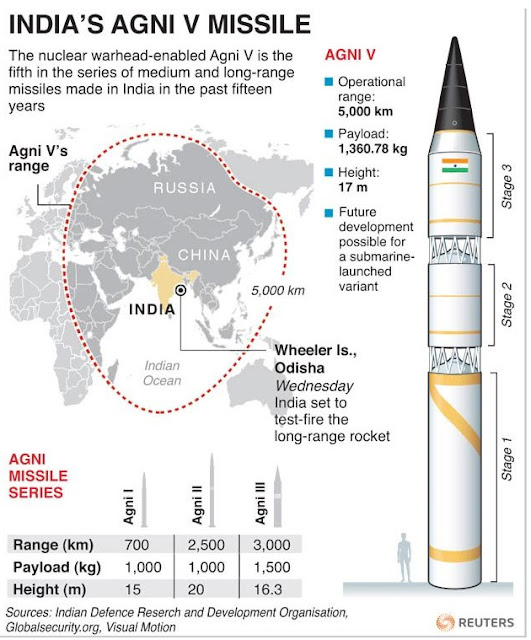
With the launch of Agni-V, India will enter the exclusive Inter-Continental Ballistic Missile club of only the permanent members of the UN Security Council - China, Russia, France, the United States and the United Kingdom.
The nuclear warhead-enabled Agni-V, with a range of more than 5,000 kilometers, will be India's longest-range missile.
The surface-to-surface missile Agni-V that can carry a pay-load of 1 tonne is 17 m long, 2 m wide and weighs 50 tonnes.
The Agni V is designed to be the most advanced version of the indigenously built Agni series. Its 3 stages are powered by solid rocket propellants and can be transported by road. The first rocket engine of Agni-V lifts it a height of about 40 km; the second stage take it up to about 150 km, while the third stage propels it about 300 km above the planet. The missile can finally achieve a height of 800 km.
With a development cost of over Rs 2,500 crore, the Agni-V is will have ring laser gyroscope and accelerometer for navigation and guidance.
The nuclear warhead-enabled Agni-V extends India's reach to the whole of Asia and Europe.
The test will take place from the launch pad-4 of the Integrated Test Range. The three stage solid fuelled missile would be put into test for the first time with some advance and indigenous technology with the support of a canisterised mobile launcher.
On the event of Agni-V test fire, countries like Indonesia, Australia, international air and maritime traffic in the test zone will be alerted well before the test as the missile will travel halfway across the Indian Ocean.
The maiden test of India's indigenously developed nuclear capable 'Agni-V' ballistic missile will be held on Wheeler Island off the Orissa coast.
The accuracy levels of Agni-V with better guidance and navigation systems, is far higher than Agni-I, Agni-II and Agni-III
The Agni-V missile has a 1,500-km longer range, as compared to the Agni-III which has a range of 3,500 km. Agni-V can blast enemy satellites in orbit and can also launch small satellites.
The payload capacity of Agni-V has been reduced leading to an increase in its range.
Agni-V will be ready for induction in the Indian armed forces in 2014-15.
Agni-V can travel faster than a bullet, carrying a nuclear weapon of about 1,000 kg. It can be fired from a mobile platform, which could be anywhere in India.
However, it can be launched only on the direct order of the prime minister of India.