Tour and Travel

Nature

Innovation

Family Health

Find out the most enjoyable moments with precious Life care and Health

Celebrity Gossip

Showing posts with label UK Conservative News. Show all posts

Sunday, 24 June 2012

0 Prince William moves 30, succeed to half of Diana's estate

The Duke of Cambridge celebrated his first anniversary with Catherine Middleton and toasted Queen Elizabeth II's Diamond Jubilee. And on Thursday, he adds another milestone to his list: his 30th birthday.
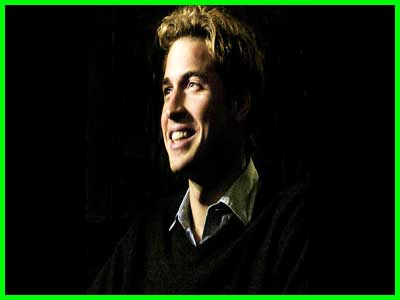
Prince William turns 30

He's now also legally entitled to half of his mother's inheritance, which was left to him after Princess Diana was killed in a car crash in 1997. His half of the inheritance, according to The Daily Telegraph, would likely be around $15.5 million, with the current currency exchange rate.

William has been in the spotlight as the eventual heir to the British throne since early childhood. He's endured his parents' breakup, his mother's death and his own big royal wedding all while the world watched along with him.

The Duke of Cambridge has recently said he and his wife are excited about the prospect of bringing a child into the world.

“I’m just very keen to have a family, and both Catherine and I, you know, are looking forward to having a family in the future," he told ABC's Katie Couric before the Diamond Jubilee.

To celebrate William's big day, we wanted to take a look back at his life. After all, many people would say that he and Catherine have helped the royal family become popular again by making the monarchy more accessible to the public.

Click through the gallery above to see William's evolution from Diana and Charles' lovable young son to the Duke of Cambridge.

Thanks: http://news.blogs.cnn.com/2012/06/21/prince-william-turns-30-inherits-half-of-dianas-estate/?hpt=us_r1

Sunday, 17 June 2012

0 Workers who lightening strike face advantage restrictions

Workers claiming benefit will lose top-up if they are responsible for a reduction in their income as a result of strike action

The government is to limit the amount of benefit paid to workers if they take part in a strike, the work and pensions secretary, Iain Duncan Smith, has announced.

Workers who lightening strike face advantage restrictions

Under changes to be introduced with the new universal credit from next year, workers claiming benefit will lose any top-up if they are responsible for a reduction in their pay as a result of joining a strike.

The worker on strike would continue to receive a basic benefit if they are in receipt of the universal credit. But if their income drops as a result of joining a strike, their universal credit will not increase.

Duncan Smith said: "It is totally wrong that the current benefit system compensates workers and tops up their income when they go on strike. This is unfair to taxpayers and creates perverse incentives. Striking is a choice, and in future benefit claimants will have to pay the price for that choice, as under universal credit, we no longer will."

Under the system, recipients of working tax credits are allowed to retain their full entitlement for the first 10 days of a strike. Ministers believe this is unfair and outdated because it is based on a system first introduced as part of the National Assistance Act in 1948.

Duncan Smith believes it is right to act after nearly 1.4m days were lost to strike action involving more than one million workers in 2011.(Google)

Brendan Barber, the general secretary of the TUC, said: "This is petty and vindictive. Workers are always reluctant to strike, depriving their families of benefits will leave low-paid workers even more vulnerable to bad treatment."

The universal credit will wrap most tax credits and benefits into a single payment. It is designed to ensure that claimants are not better off on benefits than in work.

Thanks:guardian.co.uk/society/2012

Wednesday, 13 June 2012

5 Church of England admonish Against Gay wedlock

The Church of England warned a potential change in British law that would allow same sex civil marriages would strike a wedge between church and state of almost biblical proportions, certainly the biggest since its inception some 500 years ago.

Church of England Warn Against Gay Marriage

The Church of England bishops delivered a submission to the government warning against pressing ahead with its controversial proposals of legally allowing same sex couples form civil marriage. The church believes that introducing same sex marriage would lead to the church being forced out of its role of conducting weddings on behalf of the state. In the 13-page submission, the Church claim ’Such a move would alter the intrinsic nature of marriage as a union of a man and a woman, as enshrined in human institutions throughout history.’ The document also includes, ’Marriage benefits society in many ways, not only by promoting mutuality and fidelity, but also by acknowledging an underlying biological complimentarily which for many includes the possibility of procreation.’

The UK Government defended the plans to effectively change the status of civil marriage ceremonies to allow gay and lesbian couples in England and Wales to marry. On Tuesday afternoon they advised their confidence in certain safeguards which would prevent certain religious organisations being forced to take part or officiate at same sex marriages. They also confirmed they were fully behind the change of law, vowing to put a vote to parliament and the law be changed before the end of 2015.

The deeply homophobic rooted Coalition for Marriage, that seeks to deny equal rights for gay and lesbian people, handed in a petition to the Government with over 500,000 signatures (the majority electronic) opposing same sex marriage.

A recent poll conducted by YouGov for Stonewall found that between 80 and 85 percent of the population under 50 years of age supported marriage equality, thus allowing same sex couples to marry.

“The Church of England has been loosing its place in a modern society over recent, thanks in part to their stand against equality, against women and now against gays.” A leading gay writer told me today, adding, “They are running the risk of completely detaching themselves from the bulk of British society with this sudden melodramatic outburst and blatant attempt to hijack the truth and foster an sense of false fear. All over the country they are alienating themselves from the vast majority of the population that see themselves as Christians, yet rarely go to church. If they carry on in this fashion, it wont be long before the Church of England will be an obsolete historical institution.”

Thanks: http://technorati.com/politics/article/church-of-england-warn-against-gay/#ixzz1xk94sgFu

Monday, 4 June 2012

0 Germany sells Israel Nuclear-equipped submarines

Der Spiegel has just published an important article about the Dolphin submarines Germany has been selling to Israel over the past fifteen years.  Israel now has three, with a fouth and fifth on the way and sixth in the pipeline by 2017.  Sale of up to nine submarines is contemplated by both sides.  The ostensibly big news in this story is that both the Israelis and Germans knew the subs were nuclear weapons-capable, but the Germans had denied it.  In fact, they contain a special secret hydraulic launching system designed for nuclear cruise missiles.

Germany sells Israel Nuclear-equipped submarines

But this isn’t the real news since any reasonably intelligent person would know that any submarine Israel would buy would carry nuclear weapons.  There are two truly newsworthy aspects of this story: one reported and the other not.  The reported one is that German chancellor Angela Merkel officially denied the subs would carry nukes all the while knowing they would.  That is a big story, no doubt, in Germany.  In Israel it’s pretty much a yawn, given that Israelis are used to their leaders lying through their teeth on national security and military matters.

But what has not been reported and is probably the most important aspect of this story is the major upheaval it will introduce in the Middle East balance of power.  Der Spiegel notes that the nukes on board the Dolphins will offer Israel a “second strike” capacity against any enemy who thinks to level a crippling pre-emptive blow against it.  Ostensibly, this will make a power like Iran, after it would get nuclear weapons (if it would), think twice about using the nukes since Israel’s cruise missiles will level entire Iranian cities.

But the question must be asked: who in the Middle East has the power to mount such an attack against Israel?  No one.  Iran doesn’t even have nukes and certainly can’t attack Israel without them.  There simply is no other country that could do so.  Perhaps in one’s wildest dreams one could imagine Israel and Turkey tussling with the Turks thinking of striking a crippling blow against Israel.  But essentially, no one in the Middle East could mount a first strike.  So in effect Israel is getting a weapon for a purpose that doesn’t exist.  Why should it need second strike capacity when there is no first strike possible?  It’s a little like running for president even before you’ve been elected to the school board.

From this flows an even more important development.  I recently posted about a conversation I had with noted Israeli nuclear weapons analyst Avner Cohen about the hidden impact of Israel’s nuclear arsenal on strategic military and policy matters that one would never think could be influenced by nuclear weapons.  Namely, that a nuclear-weapons-enabled Israel has no reason to compromise either with its neighbors or with its allies on any major issues like ending Occupation, returning to 1967 borders, etc.  Just as North Korea’s nukes have enabled it to maintain a surprisingly belligerent posture towards its enemies and even its Chinese friends, Israel too can thumb its nose at anyone asking it to make concessions it isn’t prepared to make.

An Israel with nukes can even tell a U.S. president that he can take his settlement freeze and shove it.  That’s precisely what Bibi Netanyahu did and Pres. Obama didn’t have the guts to pursue the matter.  After all, what leverage did Obama have unless he was willing to go to the mat and invest everything in winning?

There is another macabre irony in Germany’s sale of these weapons to Israel.  The state which inflicted the Holocaust on the Jewish people and incinerated 6 million of them in the ovens of Poland, has now dealt Israel the ability to incinerate any Arab country so bold as to stand in the way of Israeli hegemony over its little slice of the Middle East.  If an Israeli missile is ever fired at an Arab state and inflicts major damage upon it, this will be one of the first things the media will mention.  And Germany will then, too late, have some soul-searching to do about giving Israel the power to inflict its own Holocaust on the Mideast.

Ah yes, the right-wing naysayers will protest at references to an Israeli-inflicted Holocaust because it can’t and won’t happen here (or I should say, there).  Israel would never deliberately kill more than say the ten or fifteen thousand Arabs its killed since 1948.  It would never kill, say a hundred thousand or a million.  Unfortunately, history has offered up the American example of two atom bombs used against Japan within a week.  Though no one has used a nuclear weapon since, we let the bomb out of Pandora’s Box and Israel would clearly be willing to use it if it had to.  Can anyone say that they’d trust Israel’s judgment in using such a weapon as an absolute last resort to stave off national catastrophe?

Germany has offered the subs to Israel on terms that what can only be called a sweetheart deal: the seller finances one-third of the purchase price ($168-million), but Israel doesn’t make its first payment till 2015.  Is Germany that desperate for customers that it had to practically pay the Israelis to buy weapons that can incinerate half the Middle East?

It seems to me that right about this time some German moral thinkers (aside from Gunter Grass, whose criticism of the sub deal was right on the mark) and peace activists should be doing some very deep soul-searching about why their country has offered a weapon of such enormous power to a country which has done nothing but resist making peace in the region over the past 45 years or more.

It’s worthwhile noting Ehud Barak’s hearty congratulations offered to the German people:

Israeli Defence Minister Ehud Barak told SPIEGEL that Germans should be “proud” that they have secured the existence of the state of Israel “for many years.”

These weapons have done much more than secure Israel’s existence.  They’ve secured Israel’s ongoing intransigence in any matters pertaining to peace negotiations.  This in turn makes the Middle East a much more unstable place, which doesn’t render Israel more secure, but rather less.

Thanks:muslimvillage.com/2012/06/05/23902

Sunday, 3 June 2012

0 The England Queen's Diamond Jubilee: six decades of driving

On the Queen's Diamond Jubilee weekend David Williams compares life on the roads in 1952 with today.

It’s June 1952 and – being an average kind of chap – you’re bursting with pride as you drive your shiny black Austin A40 complete with column gearshift, independent front suspension and a bench front seat.

Everyone else is talking about the sudden death of George VI and the accession to the throne of his daughter, 25-year-old Elizabeth. They say she seems too young for such a burden; how are they to know that she will, 60 years on – a grandmother and Britain’s second-longest reigning monarch – again be the topic of conversation as her Diamond Jubilee is celebrated across Britain?

The England Queen's Diamond Jubilee

But as you drive to newly opened Palace House in Beaulieu, Hampshire, where Lord Montagu has just wheeled a collection of five veteran cars into the entrance hall (making it the forerunner to the National Motor Museum), you’re more interested in the whirr of the four-speed gearbox (with synchromesh on second, third and fourth) and the thrum of the 1,200cc four-cylinder engine powering your upmarket Somerset version of the A40. You considered the Morris Minor but the A40 is the top-selling car of 1952 and popular opinion can’t be wrong, can it?

The A40 cost you £727 (about £16,500 at 2012 values) compared with £631 for the four-door Morris Minor. It’s a vast amount considering that the average national wage is still just £8,415 a year (2012 values) for an average working week of 38.8 hours, (compared with the average £24,000 you could be earning six decades on for an average working week of 31.8 hours).

You’re convinced the cost was worth it, despite the AA’s 1952 Schedule of Running Costs showing that the Austin costs about 98 pence a mile to run, compared with the 45.8ppm you’ll pay for a similar car six decades on. Anyway, the top speed is a heady 70mph and she races to 60mph in a startling 31.6sec. So hold on tight and be thankful for those sturdy drum brakes all round.


Although Britain’s road network has expanded to about 185,000 miles (compared with 246,000 in 2012) there are still no motorways (the first, the Preston Bypass, won’t appear until 1958), so the Austin’s turn of speed is entirely adequate.

If she is still running in 60 years, there will be more than 2,200 miles of motorway to contend with and she’ll feel a little slow compared with the top-selling car in the Diamond Jubilee year; the Ford Fiesta, capable of 104mph and priced from £9,795. That’s inflation for you.

Congestion, however, hasn’t yet reached the levels that make Diamond Jubilee revellers wince.

With only five million vehicles on the road in 1952 compared with 34.2 million in 2012, traffic jams won’t bother you. Neither will speed cameras; they won’t be introduced until 1992 and you won’t see a roadside breathalyser for another 16 years, or the birth of the annual MoT roadworthiness test for another eight.

Petrol is hardly a concern at just 51p a gallon compared with the shocking £6.29 a gallon and more motorists will be paying in 60 years’ time. There’s certainly no trouble finding a forecourt. The golden motoring age of 1967 – when there will be 39,958 filling stations – is some way off but there are already 34,000, making 141 cars for each garage. When hunting for fuel in 2012 you’ll find there are about 8,500 forecourts, with 3,952 vehicles competing for each one.

But it’s not all rosy back in June ’52, as the court of Queen Elizabeth begins the mammoth job of planning her coronation, which will take place in a year’s time, after a suitable period of mourning for the late King.

You only have skinny cross-ply tyres keeping you on the road as you head down to Hampshire and if you do skid off, you shouldn’t rely too heavily on your A40 to keep you out of trouble. It has few safety features, no seat belts and the very notion of ABS sounds like science fiction.

By contrast, the Fiesta in 2012 will have grippy tyres, anti-lock and emergency-assist braking, a traction control system, crumple zones and airbags. No wonder the number of road deaths falls, although total casualty rates remain at a remarkably similar level.

Thanks: telegraph.co.uk/news/uknews

Monday, 28 May 2012

0 Congress Must distribute Postal Fix

The United States Postal Service does not take one dime of taxpayer money. You've heard this, I've heard this, and it is something postal employees say to me time and time again. For the most part, it is absolutely true.

It is what postal unions won't tell you that should scare every taxpayer.

distribute Postal Fix

Before I scare you, let me say that the USPS is home to hundreds of thousands of dedicated, hard-working American citizens. Many veterans wear the uniform of the Postal Service with as much pride as they wore the uniform of the armed services. Unfortunately, they and the taxpayer, are being fleeced by politicians, union leadership and a service unwilling to change.

There are those who say "privatize it." Unfortunately, no one will buy it. UPS and FedEx need the Postal Service, and the relationship is less adversarial and more symbiotic today than ever.

There are those who say, "get rid of it, I will use email." Unfortunately, you can't get pills via email, send toys to the grandkids via email or conduct some commercial enterprises without the mail.

It is not a choice between having a Postal Service and not. It is a choice of having a Postal Service that works, does not take taxpayer money and meets the needs of a 21st-century information society or a Postal Service whose only hope of survival is a taxpayer-funded bailout.

First, the facts.

In 1971, Congress created the USPS as a self-supporting, independent agency. According to the Office of Personnel Management, "Congress granted the USPS fiscal independence in exchange for a promise of fiscal responsibility." The USPS got independence, what taxpayers did not get was fiscal responsibility.

Thanks:theledger.com/article/20120529/COLUMNISTS03

Friday, 25 May 2012

0 Is NATO Still considered necessary?

Street protests in Chicago targeted a NATO summit where President Obama was promoting a gradual military withdrawal from Afghanistan. However, protesters challenged the continued need for this expensive alliance designed for the Cold War, reports Lawrence S. Wittner.

The North Atlantic Treaty Organization (better known as NATO) is in the news once again thanks to a NATO summit meeting in Chicago over the weekend of May 19-20 and to large public demonstrations in Chicago against this military pact.

NATO Still needed?

NATO’s website defines the alliance’s mission as “Peace and Security,” and shows two children lying in the grass, accompanied by a bird, a flower and the happy twittering of birds. There is no mention of the fact that NATO is the world’s most powerful military pact, or that NATO nations account for 70 percent of the world’s annual $1.74 trillion in military spending.

The organizers of the demonstrations, put together by peace and social justice groups, assailed NATO for bogging the world down in endless war and for diverting vast resources to militarism. According to a spokesperson for one of the protest groups, Peace Action: “It’s time to retire NATO and form a new alliance to address unemployment, hunger and climate change.”

NATO was launched in April 1949, at a time when Western leaders feared that the Soviet Union, if left unchecked, would invade Western Europe. The U.S. government played a key role in organizing the alliance, which brought in not only West European nations, but the United States and Canada. Dominated by the United States, NATO had a purely defensive mission — to safeguard its members from military attack, presumably by the Soviet Union.(Google)

That attack never occurred, either because it was deterred by NATO’s existence or because the Soviet government had no intention of attacking in the first place. We shall probably never know. In any case, with the end of the Cold War and the disappearance of the Soviet Union, it seemed that NATO had outlived its usefulness.

But vast military establishments, like other bureaucracies, rarely just fade away. If the original mission no longer exists, new missions can be found. And so NATO’s military might was subsequently employed to bomb Yugoslavia, to conduct counter-insurgency warfare in Afghanistan, and to bomb Libya.

Meanwhile, NATO expanded its membership and military facilities to East European nations right along Russia’s border, thus creating renewed tension with that major military power and providing it with an incentive to organize a countervailing military pact, perhaps with China.

None of this seems likely to end soon. In the days preceding the Chicago meeting, NATO’s new, sweeping role was highlighted by Oana Longescu, a NATO spokesperson, who announced that the summit would discuss “the Alliance’s overall posture in deterring and defending against the full range of threats in the twenty-first century, and take stock of NATO’s mix of conventional, nuclear, and missile defense forces.”

In fairness to NATO planners, it should be noted that, when it comes to global matters, they are operating in a relative vacuum. There are real international security problems, and some entity should certainly be addressing them.

But is NATO the proper entity? After all, NATO is a military pact, dominated by the United States and composed of a relatively small group of self-selecting European and North American nations. The vast majority of the world’s countries does not belong to NATO and has no influence upon it.

Who appointed NATO as the representative of the world’s people? Why should the public in India, in Brazil, in China, in South Africa, in Argentina, or most other nations identify with the decisions of NATO’s military commanders?

The organization that does represent the nations and people of the world is the United Nations. Designed to save the planet from “the scourge of war,” the United Nations has a Security Council (on which the United States has permanent membership) that is supposed to handle world security issues.

Unlike NATO, whose decisions are often controversial and sometimes questionable, the United Nations almost invariably comes forward with decisions that have broad international support and, furthermore, show considerable wisdom and military restraint.

The problem with UN decisions is not that they are bad ones, but that they are difficult to enforce. And the major reason for the difficulty in enforcement is that the Security Council is hamstrung by a veto that can be exercised by any one nation.

Thus, much like the filibuster in the U.S. Senate, which is making the United States less and less governable, the Security Council veto has seriously limited what the world organization is able to do in addressing global security issues.

Thus, if the leaders of NATO nations were really serious about providing children with a world in which they could play in peace among the birds and flowers, they would work to strengthen the United Nations and stop devoting vast resources to dubious wars.

Thanks:middle-east-online.com/english/?id=52444

Thursday, 17 May 2012

0 Cameron Takes Eurozone Demands To US Summit

David Cameron is set to step up his demands for action to tackle the eurozone crisis as he heads to the United States for a two-summit weekend with world leaders. 

The Prime Minister travels first to a gathering of G8 leaders at the US President's country retreat at Camp David before attending a Nato summit in Chicago.

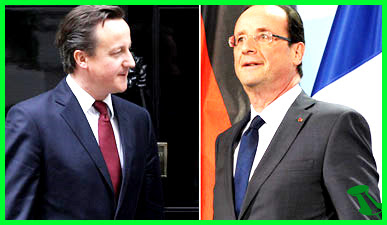
Cameron and Hollande

The G8 talks will be dominated by the eurozone crisis and the threat posed to world economies, initernational currencies and markets by the financial collapse and political vacuum in Greece.

Before leaving Downing Street, Mr Cameron took part in a 45-minute video conference, described by Number 10 as "constructive", with the other European leaders attending the G8.

Taking part were German chancellor Angela Merkel, new French president Francois Hollande, Italian premier Mario Monti and EU Commission chiefs Manuel Barosso and Herman Van Rompuy.

"He discussed with the others their priorities for G8; the Eurozone - including Greece, growth, and the importance of expanding trade relations between the US and the EU," said a Downing Street spokesperson.

"On the eurozone, the Prime Minister emphasised the importance of Greece and the Eurozone taking decisive action to ensure financial stability and prevent contagion."

Mr Cameron was said to have repeated the stark warning he issued in a speech in Manchester earlier yesterday: "That there is a need for monetary action to stimulate growth; for structural reform to increase competitiveness in the EU; that the right governance arrangements had to be in place; and that countries throughout the Eurozone should take the necessary action to tackle unsustainable deficits."

In that speech, the Prime Minister said he would do "whatever it takes to keep Britain safe from the storm", but made clear that the UK would not be immune to the consequences of a euro collapse.(Google)

And he insisted he would not ditch the Coalition Government's deficit-reduction strategy in the face of demands from Labour for a shift in focus from austerity to growth.

Before leaving Camp David for the Nato summit in Chicago, Mr Cameron will hold his first one-to-one meeting with Mr Hollande - whom he snubbed when the Socialist presidential candidate visited London earlier this year - at the British ambassador's residence in Washington.

The Prime Minister will urge the new president to rethink his pledge to pull 3,400 French troops out of Afghanistan two years ahead of Nato's planned timetable of 2014.


Wednesday, 16 May 2012

0 England PM queries single currency survival

The survival of the European single currency is in question, creating "huge risks" for Britain's economy, Prime Minister David Cameron is to say.

In his starkest warning yet of the possible failure of the euro, Mr Cameron will say that the single currency now stands "at a crossroads" and must choose between "make up" or "break up".

England PM queries single currency survival

He will promise to do "whatever is necessary" to keep Britain safe if the euro falls apart.

But he will reject Labour calls for a change of course on economic policy, insisting that his deficit-reduction strategy is bearing fruit and any relaxation now would mean longer and deeper austerity in the future.

Mr Cameron's warnings, in a high-profile speech on the economy, come amid continuing market turmoil across Europe fuelled by political uncertainty in Greece, which yesterday announced a second election in little more than a month after talks to form a coalition government failed.

Unconfirmed reports suggested that the European Central Bank has stopped lending to some Greek banks which have not been adequately recapitalised, while the country's president acknowledged that savers are withdrawing millions of euros from accounts out of fear of default and exit from the single currency.

Bank of England governor Sir Mervyn King said the eurozone was "tearing itself apart without any obvious solution" and confirmed he and his colleagues are working on contingency plans in the event of a worst-case scenario. Warning that the UK was at risk of being in the path of the eurozone storm, the Governor slashed growth forecasts for 2012, and ruled out a return to pre-financial crisis levels of growth before 2014.

Today, Mr Cameron is expected to make clear his frustration with the failure of Berlin and Paris to take the steps he believes necessary to support weaker economies in the eurozone.

Speaking to business leaders in the North West, he will say: "The eurozone is at a crossroads. It either has to make up or it is looking at a potential break-up.

Shadow chancellor Ed Balls said: "David Cameron is totally out of touch and deeply complacent if he thinks Britain is on the right course. His failed policies have pushed us into recession and the Government is now set to borrow an extra £150 billion to pay for this economic failure.

Tuesday, 15 May 2012

0 Obama walks fine line in bashing Romney, courting Wall Street

For President Barack Obama’s re-election team, it’s sort of like threading a needle. While trying to define Republican Mitt Romney as an insensitive job-killer during his time as a private equity executive, the Obama campaign also is raising money from private equity executives on Wall Street – and hoping voters don’t see that as hypocritical.

The Obama campaign’s political dexterity was evident on Monday, as it released a blistering video ad recounting how Romney’s Bain Capital laid off 750 workers from a steel mill in Missouri. Hours later, the campaign raked in about US$2 million at a Manhattan fundraiser held by Tony James, president of the Blackstone Group, a huge private equity firm.

Obama walks fine line

The Blackstone Group had been on the Obama campaign’s radar before – as a target for criticism. Last month, the campaign identified a Blackstone partner, Paul Schorr, as one of “eight wealthy individuals” who donated to Romney’s campaign after “betting against America” in “less-than-reputable” deals that led to outsourcing and layoffs.

So yesterday at the White House, Obama spokesman Jay Carney faced several questions about whether the president’s campaign was setting a double standard in dealing with Wall Street, where some executives see Obama as anti-business.

Carney rejected the notion that Obama’s team, in criticising Romney and Republican donors in private equity, had been critical only of executives who had not contributed to Obama’s campaign and that only those who support the president were “totally kosher,” in the words of ABC’s Jake Tapper.

Carney said that Obama’s campaign was being critical of individuals, not an industry.

“There is absolutely a place for a vibrant and successful financial sector … that includes private equity,” Carney said.

Not ‘against private equity’

Carney’s words were echoed by Bill Burton, who heads Priorities USA Action, a pro-Obama “Super PAC” that is spending US$4 million to put out its own version of the anti-Romney ad released by Obama’s campaign.

“The president isn’t running against the private equity industry, he is running against Mitt Romney,” Burton said. “Our ads ask whether the decisions Mitt Romney made creating incredible wealth for himself and his partners would make him a good president of the United States.”

Not surprisingly, conservatives do not see it that way.

The Wall Street Journal published an editorial yesterday that chided Obama for attacking Romney’s private equity work and then fundraising on Wall Street the same day.

The newspaper, an influential voice in conservative politics, said that those at the fundraiser, “many from the private equity world, paid US$35,800 a head for the privilege of dining with the president who purports to loathe Wall Street when he isn’t asking its greedy denizens to redistribute their wealth to his campaign.”

First impressions

Analysts said the attacks by Obama’s campaign – and the counter-punching by Romney’s team, which released a video ad showing workers from another Bain-owned steel plant praising Romney – were not surprising.

Although the election is more than five months away, the analysts said, this is a critical time in the campaign – especially for Romney.

Voters who were not focused on the Republican primaries may now be getting their first long look at Romney. So both campaigns are eager to create a lasting first impression of the Republican challenger to Obama.

“Some voters are just taking a first look at Romney, so the Obama campaign wants to shape the narrative,” said Greg Valliere of Potomac Research group, which tracks political developments for investors. “Negative ads work. Romney should know, since he eviscerated (Republican rivals) Newt Gingrich and Rick Santorum with withering attack ads in the primaries.”

Valliere questions whether accusations that Obama is being hypocritical toward the private equity industry were unlikely to gain much traction with voters, who he said already are deeply distrustful of politics – and politicians.

“I think the irony is lost on the public,” Valliere said. “Besides, he’s a politician – what would you expect?”

Romney’s campaign, which wants to focus the conversation on Obama’s handling of the sluggish economy, said the president is trying to distract voters from his own record.

In a speech in Iowa yesterday, Romney blasted Obama as an overspending, “old-school liberal” whose economic policies are damaging the country and delaying critical decisions about government spending and debt.

“What President Obama is doing is not bold,” Romney said. “It’s old.”

There were new signs yesterday of the challenge Obama could face at a time when the nation’s unemployment rate is hovering at just above 8% and the economy is growing, but growing slowly.

A new USA Today/Gallup poll found that 55% of Americans expect the economy to get better during the next four years if Romney wins the election, while only 46% said it would improve if Obama is re-elected.

And 27% expect the economy to get worse under a President Romney, compared with 37% who expect things would become more sour if Obama wins a second term

Monday, 14 May 2012

0 George Osborne: Angela Merkel damaging UK economic interests

George Osborne accused Angela Merkel of damaging Britain’s economic interests after she speculated that Greece would leave the euro.

Speaking after he arrived in Brussels for meetings with other European finance ministers about the worsening eurozone crisis, Mr Osborne implied that the German chancellor was destabilising the global economy.

George Osborne:Angela Merkel damaging UK

“The eurozone crisis is very serious and it’s having a real impact on economic growth across the European continent, including in Britain, and it’s the uncertainty that’s causing the damage,” said Mr Osborne, the Chancellor.

“Of course countries have got to make difficult decisions about their public finances. We know that in Britain. But it’s the open speculation from some members of the eurozone about the future of some countries in the eurozone which I think is doing real damage across the whole European economy.”

Earlier Mrs Merkel had warned that Greece may be forced to leave the euro if it refused to implement spending cuts agreed with the European Union.

Raising the spectre of a Greek exit, she said “solidarity for the euro” was threatened by the ongoing political crisis in Athens.

Jean-Claude Juncker, the chairman of the eurogroup of finance ministers, usually a staunch supporter of Mrs Merkel’s austerity measures, also criticised her last night, accusing Germany and other hawkish EU countries of using Greece to make “propaganda”. “I don’t envisage, even for a second, Greece leaving. It is nonsense, it is propaganda,” he said.

“I am against this way of dealing with Greece by provoking Greek public opinion. Threatening Greece day after day is not the way of dealing with partners, friends and citizens.”

Stock markets around the world fell sharply with fears mounting that a euro break-up could lead to renewed financial turmoil. The FTSE-100 index of Britain’s major companies fell by two per cent to 5465, with bank shares hit particularly hard. The cost of Spanish government borrowing also hit a record high.

The row leaves Mrs Merkel even more isolated from key eurozone allies as she faces tough negotiations on growth versus austerity with François Hollande, the new Socialist French President, in Berlin today. Mr Hollande will be sworn in and, in an indication of the concern gripping Europe, will almost immediately travel to Berlin to hold talks with Mrs Merkel that will be dominated by Greece’s plight.

Attempts to form a new government in Athens have been thwarted for the past nine days, although the country’s president will meet all major parties this afternoon to discuss forming a “technocratic” administration rather than a coalition.

An outgoing Greek minister warned that the country could descend into “civil war” amid the chaos of a euro exit.

“If Greece cannot meet its obligations and serve its debt the pain will be great,” Michalis Chrysohoidis was quoted as telling a local radio station. “What will prevail are armed gangs with Kalashnikovs and which one has the greatest number of Kalashnikovs will count … we will end up in civil war.”

New elections may be held next month and Greek voters are likely to be warned by European leaders that their country may be ejected from the euro if they do not support parties backing austerity measures.

Today, Mr Osborne may agree to looser banking rules, stipulating how much money banks must keep on their balance sheets, to allow more flexibility in responding to the turmoil.

A report from Fitch, the credit rating agency, said yesterday that the British economy may not re-emerge from recession before 2014 if there is a “shock case” of a disorderly Greek exit from the euro.

Germany and the European Central Bank are thought to have drawn up detailed plans for a Greek exit for the euro. They are designed to stop it provoking panic in other vulnerable countries, particularly Spain and Ireland.

However, this is fraught with difficulties, particularly if Greece refuses to take part in a “negotiated exit”. Mrs Merkel is under increasing pressure in Germany to force Greece out of the single currency to avert several more years of uncertainty. “I believe it’s better for the Greeks to stay in the euro area, but that also requires that we set out a path on which Greece gets back on its feet step by step,” she said.

“The solidarity for the euro will end only if Greece just says, 'We’re not keeping to the [austerity] agreement.’ But I don’t expect that to happen. I do think they are making an effort. There are many, many people in Greece who actually want it.”

Wolfgang Schaeuble, the German finance minister, said: “The price if they decide to leave the euro is very high. It would cause a huge amount of turbulence for all of us.”


Thursday, 10 May 2012

0 PM's former aide takes stand at UK ethics inquiry

A former tabloid editor who became Prime Minister David Cameron's spin doctor told Britain's media ethics inquiry Thursday that Rupert Murdoch was a hands-off owner who did not meddle in his newspapers' editorial decisions or political positions.

PM's former aide takes stand at UK ethics inquiry

Andy Coulson -- who edited the tabloid News of the World when allegations first became public that it was involved in illegal phone-hacking -- was answering questions at a judge-led inquiry that has turned its attention to the sometimes too-cozy relationship between Britain's press and politicians.

Coulson's appearance has revived questions about Cameron's decision to hire the former tabloid editor.

British politicians of all parties for years have sought the support of newspapers -- especially Murdoch's best-selling tabloids, whose backing was credited with the power to swing elections. As the hacking scandal has unfolded, unease has grown about what favors the newspapers may have received in return.

Coulson said Murdoch had never told him what party the News of the World should support while he was the paper's editor between 2003 and 2007. He said the media mogul was a "warm and supportive" boss, but was in only irregular contact.

When he did call, "we discussed politics generally and he would give me his view on whatever was in the news at the time" -- without Murdoch interfering with the paper's editorial line, Coulson said.

Coulson said he did not discuss with Murdoch which party the newspaper should support in the 2005 national election.

"I followed my own path with it," said Coulson, opting to back Tony Blair's Labour Party, which won.

Coulson has insisted he did not know that News of the World employees were hacking voicemail messages of celebrities, politicians and crime victims in a quest for scoops and circulation.

He left the paper in 2007 after a reporter and a private investigator were jailed for hacking, and became Cameron's powerful media chief later the same year, helping return the Conservatives to power at the May 2010 national election. He quit 10 Downing St. in January 2011 as the hacking scandal intensified.

The inquiry led by Lord Justice Brian Leveson has already examined newspapers' relations with the public and the police.

Leveson said he would investigate whether the media organizations' relationships with politicians had "got out of hand."

"It is obvious that politicians will want to gain support and need support for the messages they want to convey," he said. "But ... is there a risk that there is an inappropriate press influence? "

Coulson's appearance at the inquiry will be uncomfortable for the Conservative prime minister, whose relationships with senior executives of Murdoch's News Corp. have embroiled him in the hacking furor.

Cameron has close ties to Coulson and to Rebekah Brooks, another ex-News of the World editor and former chief of Murdoch's British newspapers. She is due to testify to the inquiry on Friday.

Both Coulson and Brooks have been arrested and questioned by police about tabloid wrongdoing, though neither has been charged.

Speculation is rife about what the pair will reveal about their relations with Cameron and his Conservative Party, whose popularity is already at a low amid national economic gloom.

The Murdoch-owned Times of London newspaper reported Wednesday that Brooks has retained supportive text messages from the prime minister, a personal friend, neighbor and occasional riding companion in the upmarket rural enclave of Chipping Norton.

There is an irony in Cameron's discomfort. It was the prime minister who asked Leveson to lead an inquiry to sift through the fallout of the hacking scandal that has rocked Britain's establishment and rattled Murdoch's News Corp. with revelations of widespread journalistic malpractice.

The inquiry has heard from reporters, police and public figures in an effort to understand why nothing was done earlier to stop the phone hacking.

Murdoch shut the 168-year-old News of the World in July after evidence emerged that it had intercepted the phone messages of a missing schoolgirl, Milly Dowler, who was later found murdered.

Murdoch has so far paid out millions to settle lawsuits from 60 actors, athletes, politicians and other public figures whose voicemails were hacked. Dozens more lawsuits have been filed.

Read More

Tuesday, 8 May 2012

0 Lords reform expected in Queen's Speech

The government is expected to use the Queen's Speech to push ahead with House of Lords reform, despite strong opposition from many Conservative MPs.

Plans, back by the Lib Dems, to create elected peers are likely to be included in the address - which ministers hope will rebuild unity between the parties.

The government is also expected to announce plans to split up banks and alter rules on executive pay.

The Queen will deliver her speech to MPs and peers at about 11:30 BST.

Outlining the government's legislative plans for the next session of Parliament, she is also expected to announce a bill to ensure the UK is exempt from future eurozone bailouts; moves towards televising court proceedings and the creation of a specific offence of driving under the influence of drugs.

'Fightback speech'

It is the first Queen's Speech - the grandest event on the parliamentary calendar - since shortly after the coalition was formed. The statement usually takes place each autumn.

The contents of this speech, billed by commentators as a "fightback", have reportedly been more contentious within government than usual, as the two coalition parties attempt to assert their own priorities.

The Lib Dems and Conservatives both lost hundreds of seats in last week's local elections in England and Wales, increasing demands from some backbench MPs to change direction.

The fall-out from tax changes in the Budget and claims of overly strong links between ministers and Rupert Murdoch's News International have also led to criticism.

On Monday, several senior Tories published an "alternative Queen's Speech", calling for tax cuts and referendums on the UK's future in the European Union.

And many Conservatives have demanded that a planned Lords Reform Bill - reducing Parliament's second chamber to 300 members and making it 80% elected - is delayed.

They argue that constitutional change should not be a priority during a recession.

Queen's Speech

'Smidgen of democracy'

But it looks set to go ahead after the Lib Dems have pushed for change, which all three main parties promised in their 2010 election manifestos.

On Tuesday, Deputy Prime Minister Nick Clegg appearing alongside Prime Minister, said: "A smidgen of democracy I don't think will go amiss - since we've been talking about it for about 100 years."

He added that he cared "a lot more" about economic and social reform, but argued that was not a reason to ignore the Lords.

Mr Cameron said Lords reform was "a perfectly sensible reform for Parliament to consider", but added that it was not a priority for him.

He said: "We are different parties, the Conservative Party and the Liberal Democrat party, and we don't always agree.

"But I would argue in the last two years, the government has done a lot of things that needed to be done... although we might have had different views, we put them aside. We cut the deficit for the good of the economy."

BBC deputy political editor James Landale said it was clear the government was keen to focus less on constitutional change and more on helping the economy and families.

Our correspondent said talk in recent days that the government had softened the language of Lords' reform in response to the election results were wide of the mark.

The Queen traditionally reads her speech to Parliament on goatskin vellum, which once inscribed takes at least three days for the ink to dry, he said.
'Gladden hearts'

Another key measure expected in the Queen's Speech is the Banking Reform Bill, which would split banks into separate retail and investment arms.

This followed the financial crisis, in which the banking sector was criticised for over-exposing customers to risk.

Another bill expected to be included is one exempting the UK from the new fund to help failing European economies.

The bill would ensure the UK is not liable to contribute to the European Stability Mechanism.

Treasury sources said the move would gladden the hearts of Eurosceptic Tories and was timely given all the current uncertainties, said BBC political correspondent Carole Walker.

The anticipated Enterprise and Regulatory Reform Bill would bring changes to the pay of top executives, while cutting business regulation and changing rules on employment tribunals and redundancy.

This follows outcry over the packages awarded to many business leaders, sometimes in spite of poor performances by companies.

It had been thought that the bill would include a requirement for three-quarters of shareholders to approve pay deals, but this is believed to have been dropped.

Another expected move is a proposal to overhaul public sector pensions despite opposition from unions.
Saliva tests

The Crime, Communications and Courts Bill would mean police carrying out roadside checks get equipment to test drivers' saliva for traces of illegal drugs.

It would also set up a specific offence of driving under the influence of drugs, leading to a fine of up to £5,000, a motoring ban of at least a year and a possible prison sentence.

The creation of a National Crime Agency and tougher regulation of supermarkets are also expected.

Plans for easier adoption and more flexible parental leave, along with better support for special needs pupils and improved access arrangements for divorced fathers, are also understood to be included.

It is also expected there will be a draft bill on social care included in the speech.

A Department of Health source said the government was determined to push ahead with plans to tackle social care but this would take time.

Some coalition measures have been put on hold, including a bill aimed at streamlining the regulation of universities, and another introducing greater controls on water companies taking supplies from rivers.

The speech will be followed by a Commons debate on its contents