Tour and Travel

Nature

Innovation

Family Health

Find out the most enjoyable moments with precious Life care and Health

Celebrity Gossip

Showing posts with label NATO. Show all posts

Monday, 4 June 2012

0 US drone assault 'targeted al-Qaeda deputy'

A US drone strike on Monday in Pakistan targeted al-Qaeda's second-in-command Abu Yahya al-Libi, US officials say.

They say it is still unclear whether he was among those killed in the strike on a suspected militant compound in North Waziristan, near the Afghan border.

US drone assault

Two missiles by the unmanned aircraft killed 15 people, Pakistani officials say.

Pakistan's foreign ministry strongly condemned the strike, calling it "illegal", Reuters news agency reports.
'Major blow'

A senior US official told the BBC that Libi was the target of Monday's morning strike in Hesokhel, to the east of Miranshah, the capital of North Waziristan.

The first missile struck the compound, killing three militants, Pakistani security officials said.

A second missile then killed 12 more militants who had arrived at the scene, they added.

If Libi's death is confirmed, it would be a "major blow to core of al-Qaeda", the US official told the BBC.

Washington believes that following Osama Bin Laden's death last year, Libi, an Islamic scholar from Libya, became al-Qaeda's second-in-command after Egyptian born Ayman al-Zawahiri.

Libi is reportedly in charge of day-to-day operations in Pakistan's tribal areas.

Libi was reported killed in a drone strike in Pakistan in 2009, but it turned out to be a case of mistaken identity.

Pakistan's frontier tribal region is considered a hub of activity by al-Qaeda and Taliban militants.

There have been eight US drone strikes in the past two weeks despite Pakistani demands for them to be stopped.

It was the eighth and deadliest attack since 23 March, marking a considerable upsurge in the use of the controversial US drone programme, reports the BBC's Aleem Maqbool in Islamabad.

It has come about since a deal to reopen Nato supply routes through Pakistan fell through.

The Pakistani government closed the routes six months ago in protest at a US air strike along the Afghan border in which 24 Pakistani soldiers were killed, an episode which contributed to the current crisis in relations between Washington and Islamabad, our correspondent adds.

Pakistan says the drone attacks fuel anti-US sentiment and claim civilian casualties along with militants. The US insists the strikes are effective.

The strike comes days after more details of the Obama administration's drone policy emerged in the US.

Thanks: bbc.co.uk/news

Friday, 25 May 2012

0 Is NATO Still considered necessary?

Street protests in Chicago targeted a NATO summit where President Obama was promoting a gradual military withdrawal from Afghanistan. However, protesters challenged the continued need for this expensive alliance designed for the Cold War, reports Lawrence S. Wittner.

The North Atlantic Treaty Organization (better known as NATO) is in the news once again thanks to a NATO summit meeting in Chicago over the weekend of May 19-20 and to large public demonstrations in Chicago against this military pact.

NATO Still needed?

NATO’s website defines the alliance’s mission as “Peace and Security,” and shows two children lying in the grass, accompanied by a bird, a flower and the happy twittering of birds. There is no mention of the fact that NATO is the world’s most powerful military pact, or that NATO nations account for 70 percent of the world’s annual $1.74 trillion in military spending.

The organizers of the demonstrations, put together by peace and social justice groups, assailed NATO for bogging the world down in endless war and for diverting vast resources to militarism. According to a spokesperson for one of the protest groups, Peace Action: “It’s time to retire NATO and form a new alliance to address unemployment, hunger and climate change.”

NATO was launched in April 1949, at a time when Western leaders feared that the Soviet Union, if left unchecked, would invade Western Europe. The U.S. government played a key role in organizing the alliance, which brought in not only West European nations, but the United States and Canada. Dominated by the United States, NATO had a purely defensive mission — to safeguard its members from military attack, presumably by the Soviet Union.(Google)

That attack never occurred, either because it was deterred by NATO’s existence or because the Soviet government had no intention of attacking in the first place. We shall probably never know. In any case, with the end of the Cold War and the disappearance of the Soviet Union, it seemed that NATO had outlived its usefulness.

But vast military establishments, like other bureaucracies, rarely just fade away. If the original mission no longer exists, new missions can be found. And so NATO’s military might was subsequently employed to bomb Yugoslavia, to conduct counter-insurgency warfare in Afghanistan, and to bomb Libya.

Meanwhile, NATO expanded its membership and military facilities to East European nations right along Russia’s border, thus creating renewed tension with that major military power and providing it with an incentive to organize a countervailing military pact, perhaps with China.

None of this seems likely to end soon. In the days preceding the Chicago meeting, NATO’s new, sweeping role was highlighted by Oana Longescu, a NATO spokesperson, who announced that the summit would discuss “the Alliance’s overall posture in deterring and defending against the full range of threats in the twenty-first century, and take stock of NATO’s mix of conventional, nuclear, and missile defense forces.”

In fairness to NATO planners, it should be noted that, when it comes to global matters, they are operating in a relative vacuum. There are real international security problems, and some entity should certainly be addressing them.

But is NATO the proper entity? After all, NATO is a military pact, dominated by the United States and composed of a relatively small group of self-selecting European and North American nations. The vast majority of the world’s countries does not belong to NATO and has no influence upon it.

Who appointed NATO as the representative of the world’s people? Why should the public in India, in Brazil, in China, in South Africa, in Argentina, or most other nations identify with the decisions of NATO’s military commanders?

The organization that does represent the nations and people of the world is the United Nations. Designed to save the planet from “the scourge of war,” the United Nations has a Security Council (on which the United States has permanent membership) that is supposed to handle world security issues.

Unlike NATO, whose decisions are often controversial and sometimes questionable, the United Nations almost invariably comes forward with decisions that have broad international support and, furthermore, show considerable wisdom and military restraint.

The problem with UN decisions is not that they are bad ones, but that they are difficult to enforce. And the major reason for the difficulty in enforcement is that the Security Council is hamstrung by a veto that can be exercised by any one nation.

Thus, much like the filibuster in the U.S. Senate, which is making the United States less and less governable, the Security Council veto has seriously limited what the world organization is able to do in addressing global security issues.

Thus, if the leaders of NATO nations were really serious about providing children with a world in which they could play in peace among the birds and flowers, they would work to strengthen the United Nations and stop devoting vast resources to dubious wars.

Thanks:middle-east-online.com/english/?id=52444

Wednesday, 23 May 2012

0 MPs heed announcement on G8 and NATO Summits

We'll be hearing a lot from David Cameron today. He's got PMQs, and then he's giving a statement in the Commons about the recent G8 and Nato summits in the US. The G8 summit seems to have been one of the least productive in recent years, but, with the eurozone on the brink of collapse, MPs will have plenty to ask Cameron about. And there are at least three stories in the news today that are likely to come up in some form.


David Cameron is taking PMQ

Nick Clegg has told the Financial Times (subscription) that the government is planning a "massive" increase in state-backed investment in housing and infrastructure. It sounds suspiciously like Plan B. Here's an extract.
In an interview with the Financial Times, the deputy prime minister sounded a new tone on economic policy, when he said the government's "absolute priority" was to use the government's strong balance sheet to inject credit into the economy.

Mr Clegg said the coalition was looking at "massively amplifying the principle of what we did on credit easing" – a reference to the Treasury's £20bn scheme to support lending to small businesses.
Adrian Beecroft, the Tory business adviser, has told the Daily Telegraph that Vince Cable is a "socialist" who should not be running the Deparment for Business.
claims the Business Secretary's objections to the proposals are "ideological not economic". "I think he is a socialist who found a home in the Lib Dems, so he's one of the Left," Mr Beecroft says. "I think people find it very odd that he's in charge of business and yet appears to do very little to support business."

The BBC has revealed that ministers have taken legal advice on how Britain could, or could not, intervene in a war between Israel and Iran. This is from Nick Robinson.(Google)

I have learnt that UK ministers are discussing not just the possibility of a military confrontation but what role, if any, Britain might play and whether any involvement would be legal.
Last week in London, the National Security Council discussed what would happen if the latest set of negotiations with Iran failed and if Israel carried out its threat to launch a military strike on Iran's nuclear facilities.
Ministers were told that this could trigger a wider war in the Middle East in which Iran might respond not just by attacking Israel, but also by closing the vital trade route - the Strait of Hormuz - through which more than a fifth of the world's oil shipments are carried.
I understand that the government's law officers are now examining the legality of any British involvement if this happen.

I expect we'll hear more on all three of these stories later today.

Here's the full agenda.
BBC presenters Andrew Marr and Jeremy Paxman, the Tory MP Stephen Dorrell and the Labour peer John Reid give evidence to the Leveson inquiry.

David Cameron and Ed Miliband clash at PMQs.Cameron makes to Commons statement on the G8 and Nato summits.

The Commons transport committee takes evidence on transport and the Olympics.

Kenneth Clarke, the justice secretary, gives evidence to the Commons justice committee on the Ministry of Justice.As usual, I'll be covering all the breaking political news, as well as looking at the papers and bringing you the best politics from the web. I'll post a lunchtime summary at around 1pm and another in the afternoon.

Thanks: guardian.co.uk/politics/blog/2012/may/23

Tuesday, 22 May 2012

0 US Asked to discard Cold War Nuke Approach

In run-up to the NATO Summit in Chicago on May 20, a new report is calling for abandoning the Cold War rationale and ushering in a systemic change in U. S. nuclear force structure, strategy and posture in order to address the security threats in the 21st century.

The impassioned plea has been made by the U.S. Nuclear Policy Commission of Global Zero, an international movement for the elimination of all nuclear weapons.

According to General James E. Cartwright, who heads the Commission, the U.S. nuclear deterrence could be guaranteed with a total arsenal of between 500 and 900 warheads, and with only half of them deployed at any one time.

Even those in the field would be taken off hair triggers, requiring 24 to 72 hours for launching, to reduce the chance of accidental war, says General Cartwright, the retired vice chairman of the Joint Chiefs of Staff and a former commander of the United States’ nuclear forces.

The Obama administration is reportedly considering at least three options for lower total numbers of deployed strategic nuclear weapons: reducing their numbers to 1,000 to 1,100; 700 to 800; or 300 to 400. The Global Zero report calls for such weapons to be reduced to about 450, while maintaining an equal number of stored weapons.

The U.S. and Russia have an estimated 5,000 nuclear weapons each, either deployed or in reserve. The two countries are already on track to reduce to 1,550 deployed strategic warheads by 2018, as required by the New START treaty.

“The strategy inherited from the Cold War which remains in place artificially sustains nuclear stockpiles that are much larger than required for deterrence today and that have scant efficacy in dealing with the main contemporary threats to U. S. and global security – nuclear proliferation, terrorism, cyber warfare and a multitude of other threats stemming from the diffusion of power in the world today,” says the report.

The 26-page report Modernizing U.S. Nuclear Strategy, Force Structure and Posture Current avers that U. S. nuclear policy “focuses too narrowly on threats rooted in Cold War thinking, incurring excessive costs to prepare for an implausible contingency of nuclear war with Russia when there is no conceivable circumstance in which either country’s interest would be served by deliberately initiating such a conflict.”

The report warns that current U. S. nuclear policy also unnecessarily incurs risks of unintentionally initiating a nuclear conflict. By maintaining launch-ready nuclear postures just as they did during the Cold War, the United States and Russia run risks of nuclear mistakes that could have catastrophic consequences.

Continue reductions


The Global Zero report notes that the U. S. and Russian arsenals have been steadily shrinking since the end of the Cold War 20 years ago and pleads for continuing these reductions. “Steep bilateral reductions in all categories of weapons in their stockpiles are warranted and should be pursued in the next round of U. S.- Russian negotiations. An arsenal of 500-900 total weapons on each side would easily meet reasonable requirements of deterrence and would set the stage to initiate multilateral nuclear arms reductions involving all countries with nuclear weapons,” says the report.

The United States should seek to achieve such reductions in ten years and plan to base its arsenal on a dyad of nuclear delivery vehicles, the report advises. The optimal mix of carriers would consist of ten Trident ballistic missile submarines and eighteen B-2 bombers.

General Cartwright and his team are of the view that under normal conditions, one-half of the warhead stockpile would be deployed on these carriers; the other half would be kept in reserve except during a national emergency. All land-based intercontinental missiles armed with nuclear payloads would be retired along with the carriers of non-strategic nuclear warheads, all of which would be eliminated from the stockpile. B-52 heavy bombers would be completely dismantled or converted to carry only conventional weapons.


Increase warning time

The report further asks the U.S. and Russia should to devise ways to increase warning and decision time in the command and control of their smaller arsenals. The current postures of launch-ready nuclear forces that provide minutes and seconds of warning and decision time should be replaced by postures that allow 24-72 hours on which to assess threats and exercise national direction over the employment of nuclear forces.

“This change would greatly reduce the risks of mistaken, ill-considered and accidental launch. It would also strengthen strategic stability by removing the threat of sudden, surprise first strikes. Any move by one side to massively generate nuclear forces to launch-ready status would provide ample warning for the other side to disperse its nuclear forces to invulnerable positions,” says the report.

It adds: “By increasing warning time through de-alerting, the new postures would actually increase force survivability and diminish the adverse impact of missile defences in the equation. Missile defenses would be less threatening to the other side’s larger retaliatory force and less undermining of the other side’s confidence in its ability to carry out effective retaliation.”

In the context of such reduced reliance on offensive nuclear weapons on launch-ready alert, the United States would increase its reliance on missile defences and advanced conventional forces in an integrated new strategy, explains the report.(Google)

The Global Zero expects these non-nuclear forces to replace nuclear forces. Their role in deterring and defeating a 21st century adversary, and in reassuring U. S. allies of Washington’s commitment to their defence, would be especially important during the 24-72 hour period prior to the possible generation of offensive nuclear capability. This time-limited role, however, would reduce the requirements imposed on missile defences and conventional forces. Missile defence architecture in particular could be scaled down, says the report.

The study further advises the U.S. to broaden the agenda of nuclear arms regulation to include all categories of weapons in all nuclear weapons countries. “Only a broad multilateral approach can effectively address the multitude of serious nuclear dangers found in other parts of the world. While pursuing bilateral negotiations to reduce the U. S. and Russian stockpiles to much lower levels, the two sides should initiate a multilateral process that would seek to cap, freeze, reduce and otherwise constrain the arsenals of third countries. Nuclear arms regulation must become comprehensive and universal,” Global Zero experts say.

They plead for extending multilateralism beyond nuclear arms reductions into the realm of multilateral security cooperation.

Thanks: eurasiareview.com

Monday, 21 May 2012

0 Leader Putin and The Middle East – psychoanalysis

On 7 May this year, Vladimir Putin returned to the Kremlin with a grandiose ceremony and he is now closely preparing the first foreign policy measures in his third term as president of Russia. Such measure is the appointment of Dmitry Medvedev to participate at the 38th G8 summit in Camp Davis, on 18-19 May. Also, Russia will host the G8 summit in 2014. Furthermore, everyone knows Putin decided not to participate in the NATO summit in Chicago: he expressed that choice even before winning the elections and his decision is causing a great deal of speculations. However, it appears one of his first foreign meetings as a president is going to be with his American homologue, even if Obama’s term is close to the end or maybe precisely because of that.

Putin and The Middle East

The international media is currently considering the possibility of Putin visiting Israel one more time (he did that first in 2005), shortly after his meeting with Barak Obama. The ties between Russia and Israel have become stronger during the last two decades also because over one million Jews emigrated from the former USSR to Israel, and the members of the Russian- speaking Jewish community have occupied influential positions in the Israeli politics as well as in the economic, scientific and cultural life, thus contributing to the development of the relations be- tween the two countries.

There is also another relevant aspect: the Middle East has regained its status of competition arena between Russia and the Western countries, especially the USA. During the Cold War, Russia lost its influence in Egypt, as well as the Egyptian and Libyan military navy bases. After 1990, Russia lost yet another important Arab country where they had had a strong influence – Iraq. Therefore, in order to maintain an important area of influence in the Middle East, Russia granted constant support to the current Syrian regime and kept its only military navy base in the Mediterranean in Tartus. Considering the new developments within the Arab Awakening, Russia is now using all opportunities to promote its interests in the area and to recuperate the lost positions and image (many times Russia is seen as a supporter of the oppressive regimes); to this end, Israel can play an important role. Of course, it does not mean Russia will neglect its relations with another power pole in the area, Saudi Arabia (president Putin was the first Russian head of state to pay an official visit in Saudi Arabia in 2007, and then he went on to Qatar and Jordan). Also, Russia will maintain good cooperation relations with the Gulf Cooperation Council countries in the fields of technology and the military. Actually, we believe Russia will maintain its positions regarding several important regional issues such as the conflict with Iran and the peace process between Israel and Palestine by adopting a foreign policy of keeping in contact with all parts, without neglecting to support its allies and at the same time negotiating with their opponents.

Furthermore, Russia appears to be interested in getting involved in the new relations now developing between Israel, Greece and Cyprus. This can facilitate a strengthened position for the Russians in east Mediterranean region, including the promoting of Russian economic interests, considering the newly discovered natural gas resources; also, it can be a valid counterbalance to the Turkish influence in the area. At the same time, Israel will try to use the Russian intentions to its advantage, in order to fight back some anti-Israeli positions and promote its own interests in the region. However, Israel will surely remain the main partner to the US strategy in the Middle East and will not develop relations with Russia to the detriment of this partnership; in its turn, Rus- sia is aware of this arrangement.

Russia’s main concern on our continent is to keep Europe divided as well as to develop a new strategy considering the current European situation. In the meantime, Russia pays special attention to the Middle East in order to promote and defend the Russian national interests. In this respect, a potential partnership with Israel can be beneficial to both parts, and not just for the Mid- dle East but for other areas as well, such as the Caucasus. Most likely, Russia will succeed in maintaining a relevant presence in the Middle East; however, the Russian position is never going to return to what it used to be in the beginning of the Cold War.

News From:eurasiareview.com

0 President Obama trips Joplin one year after Tornado, speaks at High School Inauguration

President Obama took a break from the world stage and the campaign trail late Monday to heap praise on this southwestern Missouri city a year after a giant tornado cut a deadly path through the area, claiming 161 lives.

Obama told graduating seniors of Joplin High School that their story of loss and resilience is an American story — of community, kindness and generosity in which people’s best instincts triumph over greed.(Google)

Obama speaks at the Joplin High School

“As you take on the roles of colleague and neighbor and citizen, you will encounter all kinds of divisions between groups — divisions of race and religion and ideology,” the president said. “But you are from Joplin. So you will know that it’s always possible for a community to come together when it matters most.”

It was graduation night on May 22, 2011, too, when Joplin High School and more than 7,500 other buildings were destroyed by one of the deadliest and costliest tornadoes in U.S. history. The storm was a mile wide and packed winds of more than 200 mph. In Joplin and nearby Duquesne, the storm reduced schools, businesses and homes to giant swaths of lumber and rubble.

On-the-scene videos that surfaced in the days after the Joplin tornado tell the tale of the storm’s power. One compilation of security-camera footage from inside Joplin High School shows a darkened and empty complex suddenly jarred to life by roaring winds and falling debris. Music stands are tossed across a band room, and lunch tables careen across the cafeteria before the building’s ceiling caves in.

There were also heartbreaking stories of loss, among them the fate of Will Norton, sucked out of his father’s car on the way home from his high school graduation. A week later he was found dead. In all, seven Joplin students were among those killed.

A year later, the recovery still has a long way to go in this city of 50,000. Hundreds remain in temporary housing. Gnarled and half-bare trees stand alone where they once shaded houses. Concrete pads lie where churches stood, and vinyl banners flap in the wind, directing worshipers to temporary quarters. Joplin High School is a giant pile of debris, the building finally demolished this year to make way for its replacement.

But the school is a symbol of the accomplishments, too. Although the building was lost, officials were able to open a makeshift replacement in time for the 2011-12 school year to keep the students from scattering to surrounding schools. Along the construction fence that encloses the school property, dozens of painted wooden butterflies and stars bear messages such as “Faith,” “Hope” and “U.S.A.”

“Teachers worked extra hours, and coaches improvised,” Obama told a crowd of about 4,600 packed into the gymnasium of Missouri Southern State University. “The mall was turned into classrooms, and the food court became a cafeteria — which sounds like a bit of an improvement. Sure, the arrangements might have been a little noisy and a little improvised, but you hunkered down and you made it work. Together.”

Said Joplin Schools Superintendent C.J. Huff, “This class, quite simply, has been amazing.”

Obama also celebrated the generosity of others, including the 50,000 who came from across the country to help Joplin rebuild.

Obama was joined at the graduation by Missouri Gov. Jay Nixon (D). The president left politics and policy behind at his previous stop, Chicago, where earlier Monday he wrapped up a NATO summit focused on the drawdown in Afghanistan — and where, during a news conference, he defended his reelection campaign’s attacks on Republican Mitt Romney’s years as a private equity manager at Bain Capital.

In Joplin, meanwhile, Obama spoke of harnessing the same spirit that possessed this city over the past year to “help rebuild America.”

“You are from Joplin,” he said. “You are from America. And no matter how tough times get, you will be tougher. No matter what life throws at you, you will be ready. You will not be defined by the difficulties you face but how you respond — with strength, and grace, and a commitment to others.”

News From: washingtonpost.com/politics/

Sunday, 20 May 2012

0 NATO shifts to help an elusive Afghanistan peace

President Barack Obama and NATO allies declared Sunday that the end of the long and unpopular Afghanistan war is in sight even as they struggled to hold their fighting force together in the face of dwindling patience and shaky unity.

From his hometown and the city where his re-election operation hums, Obama spoke of a post-2014 world when "the Afghan war as we understand it is over." Until then, though, remaining U.S. and allied troops face the continued likelihood of fierce combat.

G8 Summit Chicago 2012

Gen. John Allen, the top commander of U.S. and NATO forces in Afghanistan, offered a stern warning Sunday that the plan to give Afghan forces the lead in fighting next summer won't take coalition troops out of harm's way. "It doesn't mean that we won't be fighting," Allen said. "It doesn't mean that there won't be combat."

The fate of the war is both the center of this summit and a topic no one is celebrating as a mission accomplished. The alliance already has one foot out the Afghanistan door, Obama has his ear attuned to the politics of an economy-driven presidential election year and other allies are pinching pennies in a European debt crisis.

As NATO powers and other nations contributing to the war effort gathered, the alliance's top officer, Anders Fogh Rasmussen, asserted that "there will be no rush for the exits" in Afghanistan. "Our goal, our strategy, our timetable remain unchanged," he said.

In fact, the strategy has shifted many times over the course of more than 10 years of war, and the goal narrowed to objectives focused on the long-term security of the mostly Western nations fighting there. The timetable has also moved, despite the overall commitment to keep foreign forces in Afghanistan into 2014.

Tension over newly elected French President Francois Hollande's pledge to end his country's combat mission two years early infused the meeting. German Chancellor Angela Merkel pointedly cited the credo of the allies in the Afghanistan war, "in together, out together," and her foreign minister cautioned against a "withdrawal competition" by coalition countries.

Hollande said he was merely being pragmatic in keeping a campaign pledge to pull combat troops this year but this still would "let the alliance continue to work."

While France's new posture obviously rattled the leaders, Allen betrayed no concern about the coalition's common purpose coming unglued. "The mantra of this particular mission has been in together, out together," he told reporters. "And I'm not seeing, frankly, many voices being raised that would oppose that."

Thursday, 17 May 2012

0 Cameron Takes Eurozone Demands To US Summit

David Cameron is set to step up his demands for action to tackle the eurozone crisis as he heads to the United States for a two-summit weekend with world leaders. 

The Prime Minister travels first to a gathering of G8 leaders at the US President's country retreat at Camp David before attending a Nato summit in Chicago.

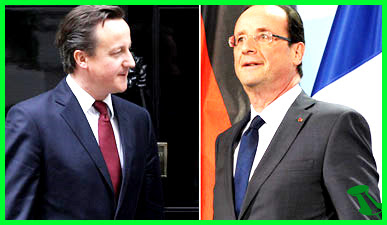
Cameron and Hollande

The G8 talks will be dominated by the eurozone crisis and the threat posed to world economies, initernational currencies and markets by the financial collapse and political vacuum in Greece.

Before leaving Downing Street, Mr Cameron took part in a 45-minute video conference, described by Number 10 as "constructive", with the other European leaders attending the G8.

Taking part were German chancellor Angela Merkel, new French president Francois Hollande, Italian premier Mario Monti and EU Commission chiefs Manuel Barosso and Herman Van Rompuy.

"He discussed with the others their priorities for G8; the Eurozone - including Greece, growth, and the importance of expanding trade relations between the US and the EU," said a Downing Street spokesperson.

"On the eurozone, the Prime Minister emphasised the importance of Greece and the Eurozone taking decisive action to ensure financial stability and prevent contagion."

Mr Cameron was said to have repeated the stark warning he issued in a speech in Manchester earlier yesterday: "That there is a need for monetary action to stimulate growth; for structural reform to increase competitiveness in the EU; that the right governance arrangements had to be in place; and that countries throughout the Eurozone should take the necessary action to tackle unsustainable deficits."

In that speech, the Prime Minister said he would do "whatever it takes to keep Britain safe from the storm", but made clear that the UK would not be immune to the consequences of a euro collapse.(Google)

And he insisted he would not ditch the Coalition Government's deficit-reduction strategy in the face of demands from Labour for a shift in focus from austerity to growth.

Before leaving Camp David for the Nato summit in Chicago, Mr Cameron will hold his first one-to-one meeting with Mr Hollande - whom he snubbed when the Socialist presidential candidate visited London earlier this year - at the British ambassador's residence in Washington.

The Prime Minister will urge the new president to rethink his pledge to pull 3,400 French troops out of Afghanistan two years ahead of Nato's planned timetable of 2014.


Monday, 14 May 2012

0 NATO supply issue linked with 48 countries, not just US: Gilani

Pakistan’s relationship with 48 countries serving in the North Atlantic Treaty Organisation (Nato) cannot be put on stake just because of the US, said Prime Minister Yousaf Raza Gilani on Monday.

While indicating a possible shift in the policy towards Nato supply routes, Gilani said, “this is not a matter of one country, the issue of Nato supply is linked with 48 countries.”

Yousaf Raza Gilani and Hina Rabbani Khar

The prime minister was speaking to the media after addressing a visiting 100-member youth delegation from China at the Prime Minister House.

Gilani was of the view that “talks between Pakistan and the US are going on regarding the resumption of Nato supplies in the light of parliament’s recommendations, but ties with Nato-Isaf and the US should be settled through dialogue on an undeviating basis.”

Gilani voiced that Pakistan desires good relations with the entire international community including its neighbouring countries.

The prime minister’s statement endorsed the given earlier by Foreign Minister Hina Rabbani Khar.

Khar was the first official from Pakistan who hinted towards a green signal to reopen the Nato supply route five months after its closure, saying Pakistan would be the one to suffer more if the supplies remain suspended for an indefinite time span.

Last week, Secretary General Nato Andres Fogh Rasmussen had opined that Pakistan should restore the supply route and he also declared that Pakistan had not been listed among the countries invited to attend the Chicago Summit.

Pakistan had closed down supply routes for the Nato forces in Afghanistan after a fatal attack on a bordering check post of the Pakistan army in Mohmand on November 26. The attack had left at least 24 Pakistani soldiers dead.

Earlier during the day, Gilani apprised President Asif Ali Zardari on his UK visit, in which the president lauded the premier’s efforts of getting a positive outcome of the visit.

The president articulated his sheer confidence that Gilani’s visit will further strengthen the bilateral relations between Pakistan and the United Kingdom.

The two leaders also discussed the impending restoration of Nato supply routes and also discussed the overall political situation in the country.

0 Russia needs missile defense system in Latin American states

A meeting on the deployment of U.S. missile defense system in Europe organized by Russia has ended in failure. NATO officials watched the videos about their defense knocking out Russian missiles, the Defense Ministry once again explained that the European missile defense is a threat to Russia, and promised to attack preemptively should the need arise. Is it time we move from a dull hopeless defense to offense?

The meeting held in early May in Moscow was doomed to failure because of the reluctance of NATO to cancel their plans of deploying mobile missile defense system in Europe. At the summit to be held in Chicago on May 21-24, NATO will announce that the first of four planned stages has reached its operational capability. This means the involvement of naval combat information and multi-function control system Aegis in the Mediterranean Sea. The system is equipped with a radar range of 400 kilometers and interceptor missiles SM-3 (Block 1). This system will interact with the early-warning radar system in Turkey.

Russia needs missile defense system

At the second stage, according to Assistant U.S. Secretary of Defense Madeleine Kridon, Washington will set the interceptor missiles in Romania (Block IIA), at the third - in Poland (Block IIB) while building the Aegis group in the Mediterranean and northern seas. These missiles are estimated to not be able to reach Russia, the zone of destruction is 250 kilometers, and their purpose, indeed, is the compensation of threats from Iran.

But at the fourth stage after 2018, as expected, the system will be modified (SM-3 Block IIB), and the zone of destruction would include intercontinental missiles "Topol" and heavy missiles deployed between Moscow and the Urals. It is these rockets of new generation that will bring down Russian "Topol" in the case of a retaliatory nuclear strike against the United States. Therefore, the Chief of General Staff Nikolai Makarov in the presence of representatives of 50 countries threatened that "in the event of a crisis Russia would deal preemptive strikes against targets in Poland and other Eastern European countries." This is an excellent statement, but too hypothetical, since there is no crisis or missiles yet.

Both sides are waiting for new approaches. Thus, a political analyst Sergei Markov told The Christian Science Monitor: "We believe that the U.S. could implement its plan, but it will lead to a new arms race, so they must return to the table with fresh approaches." What are these approaches for Russia? This would be the acceptance of proposals for a joint participation in the U.S. missile defense system and the admission of the Russian command to the "trigger" or separation of the tracking zones, which would prevent the United States or NATO from scanning the territory of Russia. But these approaches are unacceptable and will never be allowed by the Americans because Russia is not their ally, and it cannot be given a veto power. Indeed, missiles fired from Iran or Korea would probably cross the Russian territory, but they cannot rely on the Russians in this case.

The second Russian request for a legally binding treaty on the European missile defense not directed against Russia is also unrealistic. How would the Americans agree to this if they really are afraid of the restoration of the "evil empire"? Iran's horror story and al-Qaeda have been "arranged" by them after the collapse of the Soviet Union to justify the existence of a giant military-industrial complex of the U.S., ensuring their strategic interests in the world, and above all - the access to oil and gas. But Russia is still perceived as the enemy number one - this was recently stated by a Republican Mitt Romney.

What are the new approaches of the Americans? They are not more realistic. Richard Weitz, Senior Fellow at the Hudson Institute, places high hopes on the return of Putin to presidency. According to him, in 2001 (after September 11) he made a "realistic choice" and "supported" the proposal of President Bush to waive the provisions of the ABM Treaty of 1972 to avoid the destruction of perceived new partnerships in Russia and the United States in combating international terrorism. Putin, who suspended the Treaty on Conventional Armed Forces in Europe of 1990, is very different today. The hope for a return of the "realistic" Putin is as utopian as a joint missile defense system.

Incidentally, this issue was discussed a decade ago. "Creation of a strategically significant missile defense system with NATO is utopian. To prevent the missile strike on the territory of Russia, we, whether we like it or not, in the future will have to create while simplistic, but a duplicate of our own national missile defense system," Andrei Shmygin wrote in his article American defense: attack on Russia. Judging by the agitation in the Russian military circles, these days it is economically realistic, but then, in 2001, the Americans, offering a joint missile defense system, were not completely honest, knowing that a weak Russia did not have the money for it.

Of course, the U.S. will deploy a defense system in Europe without any guarantees for Russia. In this sense, the statement by the Chief of General Staff Makarov that Moscow "did not trust Washington on missile defense" is naive. When can the United States generally be trusted in the matters of military confrontation? But the Americans have their own issues. According to U.S. analysts, even the first unit has functional problems, particularly in the identification and tracking of warheads. Second, the NATO is no longer an alliance. There were problems in Afghanistan, Libya, and they exist on the issue of European defense both politically, and financially.

The situation is also unfavorable for the United States. The public debt and unemployment are on the rise, the Republican Congress often does not support the Democratic president. Many innovations at the fourth stage are frozen, for example, the program that would create a space interceptors and Airborne Laser. Therefore, the embodiment of plans for the implementation of a dangerous step for Russia is delayed for ten years.

Then, if we run the hypothetical situation, why the Russian side does not adopt a new one? Having read the American press that considers the "trump card" of the Russian Defense Ministry - a film about choking of the Russian nuclear attack on the U.S. - as a manifestation of fear, one realizes the urgency of the need to change the strategy.

This brings to mind a demarche of Khrushchev, who, in response to the deployment of U.S. missiles in Turkey, secretly ferried Soviet missiles in Cuba. Of course, the world has experienced unpleasant moments, but the Americans have to respect Russia as a full partner. Today, the world will not be on the brink of a war if Russia develops a plan for a missile defense of its allies in Latin America, for example, from the consequences of a possible conflict between Britain and Argentina. Who are Russia's allies if not Chavez and Ortega, who, without hesitation, acknowledged the independence of South Ossetia and Abkhazia? Now is the opportune moment to seek an ally in Cristina Fernandez de Kirchner. The idea is not as absurd as it may seem at first.

Find another option, but change the tactics of negotiations with the defense on the offensive and start creating Russian defense near the borders of the United States, especially since we are talking about ship systems. In addition, the U.S. spends three times more to protect its advanced bases and allies than their own territory. This is stated, for example, by Baker Spring in The Cutting Edge. The Americans must be forced to pay attention to their borders.

In this sense, articulated responses to the placement of the latest Russian air-defense (radar, "Iskander," ships in the waters of the Baltic Sea and Mediterranean Sea) are a good and appropriate response, but temporary and presenting no threat to NATO. "Space" project of Rogozin is also unrealistic and prohibitive.

Wednesday, 18 April 2012

2 India tests Agni-V missile; capable of reaching China

India test-fired a long range missile capable of reaching deep into China and Europe on Thursday, thrusting the emerging Asian power into an elite club of nations with intercontinental nuclear weapons capabilities.

A scientist at the launch site said the launch was successful, minutes after television images showed the rocket with a range of more than 5,000 km (3,100 miles) blasting through clouds from the Wheeler Island off Odisha coast.

"It has met all the mission objectives," S.P.Dash, director of the test range, told Reuters. "It hit the target with very good accuracy."

The Indian-made Agni V is the crowning achievement of a now-mothballed missile programme developed primarily with a possible threat from neighbouring China in mind.

Only the U.N. Security Council permanent members - China, France, Russia the United States and Britain - along with Israel, are believed to have such long-range weapons.

Fast emerging as a world economic power, India is keen to play a larger role on the global stage and has long angled for a permanent seat on the Security Council. In recent years it has emerged as the world's top arms importer as it rushes to upgrade equipment for a large but outdated military.

"It is one of the ways of signalling India's arrival on the global stage, that India deserves to be sitting at the high table," said Harsh Pant, a defence expert at King's College, London, describing the launch as a "confidence boost".

The launch, which was flagged well in advance, has attracted none of the criticism from the West faced by hermit state North Korea for a failed bid to send up a similar rocket last week.

But China noted the launch with disapproval.

"The West chooses to overlook India's disregard of nuclear and missile control treaties," China's Global Times newspaper said in an editorial published before the launch, which was delayed by a day because of bad weather.

"India should not overestimate its strength," said the paper, which is owned by the Chinese Communist Party's main mouthpiece the People's Daily.

India has not signed the non-proliferation treaty for nuclear nations, but enjoys a de facto legitimacy for its arsenal, boosted by a landmark 2008 deal with the United States.

On Wednesday, NATO said it did not consider India a threat. The U.S. State Department said India's non-proliferation record was "solid," while urging restraint.

INSIDE CHINA

India says its nuclear weapons programme is for deterrence only. It is close to completing a nuclear submarine that will increase its ability to launch a counter strike if it were attacked.

India lost a brief Himalayan border war with its larger neighbour, China, in 1962 and has ever since strived to improve its defences. In recent years the government has fretted over China's enhanced military presence near the border.

Thursday's launch may prompt a renewed push from within India's defence establishment to build a fully fledged intercontinental ballistic missile (ICBM) programme capable of reaching the Americas, though some of India's allies may bridle at such an ambition.

"Policy-wise it becomes more complicated from now on, until Agni V, India really has been able to make a case about its strategic objectives, but as it moves into the ICBM frontier there'll be more questions asked," said Pant.

The Agni V is the most advanced version of the indigenously built Agni, or Fire, series, part of a programme that started in the 1960s. Earlier versions could reach old rival Pakistan and Western China.

"India can now deter China, it can impose maximum possible punishment if China crosses the red line," Srikanth Kondapalli, professor in Chinese studies at Jawaharlal Nehru University told Reuters.

The rocket is powered by easier-to-use solid rocket propellants and can be transported by road.

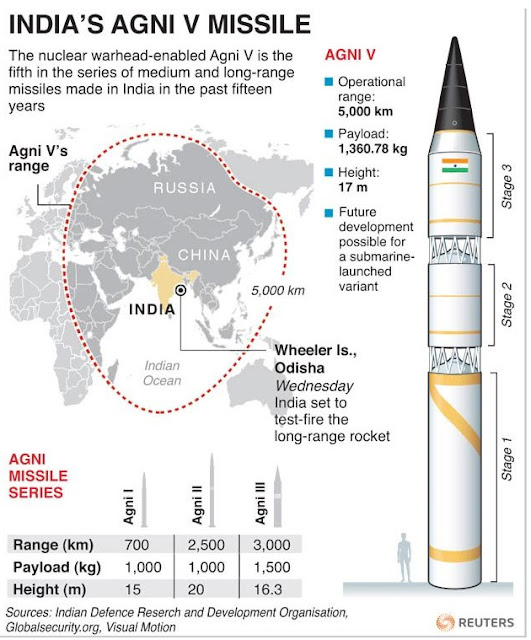
Agni V
With the launch of Agni-V, India will enter the exclusive Inter-Continental Ballistic Missile club of only the permanent members of the UN Security Council - China, Russia, France, the United States and the United Kingdom.

The nuclear warhead-enabled Agni-V, with a range of more than 5,000 kilometers, will be India's longest-range missile.

The surface-to-surface missile Agni-V that can carry a pay-load of 1 tonne is 17 m long, 2 m wide and weighs 50 tonnes.

The Agni V is designed to be the most advanced version of the indigenously built Agni series. Its 3 stages are powered by solid rocket propellants and can be transported by road. The first rocket engine of Agni-V lifts it a height of about 40 km; the second stage take it up to about 150 km, while the third stage propels it about 300 km above the planet. The missile can finally achieve a height of 800 km.

With a development cost of over Rs 2,500 crore, the Agni-V is will have ring laser gyroscope and accelerometer for navigation and guidance.

The nuclear warhead-enabled Agni-V extends India's reach to the whole of Asia and Europe.

The test will take place from the launch pad-4 of the Integrated Test Range. The three stage solid fuelled missile would be put into test for the first time with some advance and indigenous technology with the support of a canisterised mobile launcher.


On the event of Agni-V test fire, countries like Indonesia, Australia, international air and maritime traffic in the test zone will be alerted well before the test as the missile will travel halfway across the Indian Ocean.

The maiden test of India's indigenously developed nuclear capable 'Agni-V' ballistic missile will be held on Wheeler Island off the Orissa coast.

The accuracy levels of Agni-V with better guidance and navigation systems, is far higher than Agni-I, Agni-II and Agni-III

The Agni-V missile has a 1,500-km longer range, as compared to the Agni-III which has a range of 3,500 km. Agni-V can blast enemy satellites in orbit and can also launch small satellites.

The payload capacity of Agni-V has been reduced leading to an increase in its range.

Agni-V will be ready for induction in the Indian armed forces in 2014-15.

Agni-V can travel faster than a bullet, carrying a nuclear weapon of about 1,000 kg. It can be fired from a mobile platform, which could be anywhere in India.

However, it can be launched only on the direct order of the prime minister of India.